
You click a button as a timer races down to zero. You click as fast as you can before the timer bottoms out, which it inevitably does. For each click, you’ve earned a point, and after accumulating enough, you’re able to spend those points on an upgrade. Now, your one click counts for two. Soon, your clicking days are behind you, offloaded onto a machine that does the clicking. You have enough points to buy several of these machines, which hum industriously along, eventually paying for their own upgrades. Finally, you reach a point where even the impressive click-through of your network of machines falls short of the upgrades you so desperately need, so you do the only thing left: wipe it all away for a game-changing stat boost.
You start over again.
And again.
And again.
It is so simple and transparently manipulative that nobody should fall for it more than once. Yet, on mobile devices, PCs, and consoles, this gameplay loop has proven so indelibly satisfying that millions of gamers cannot extricate themselves from it. And what’s more, they don’t want to. Genres that seemed, in the days of Cookie Clicker, Universal Paper Clips and Progress Quest, like mere novelties with an obvious shelf life have grown into some of the best-represented and most widely chosen options in the entire gaming marketplace. Idles and incrementals are pure anomalies: jokes that somehow get funnier with each retelling.
There is a satisfying symmetry between the stratospheric rise of these genres and the exponential growth that remains one of their defining mechanics. At their core, these are games about numbers—perhaps no more so than other genres, but certainly more blatantly. And both within these games and without, the number does, indeed, go up.
So let’s get into it. One measure of a genre’s growth is the sheer number of games being released. In 2020, 185 games tagged “Incremental” were added to Steam (though the tag itself would not be introduced until May 2026). By 2025, that number had reached 1,311—an astonishing 7.1-fold increase. Impressive as that is, the figure is dwarfed by 2026’s releases. At 2,585 at the time of writing, the total is already approaching twice that of the previous year.
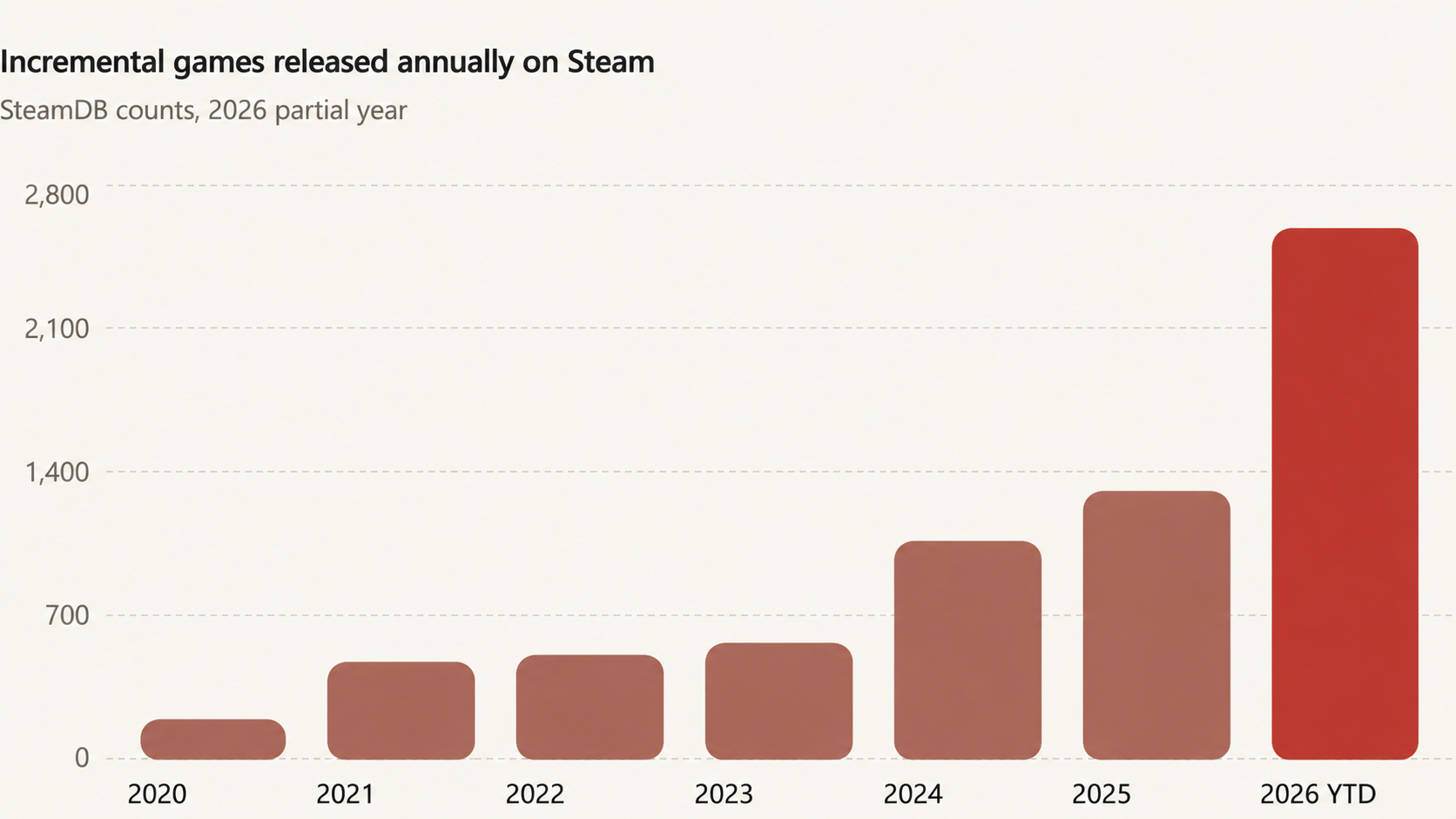
Of course, these releases would count for nothing if nobody were playing them. To that end, GameCharts reports a 22% increase in average monthly players for games tagged “Idler” between January and October 2026, compared with the same period in 2025. For games tagged “Incremental,” that figure rises to 24%.
Astute readers will have already noticed that the increase in players is considerably more modest than the explosion in releases. PlayRecon notes that 46% of incrementals in its three-year-to-90-day sample never reached ten Steam reviews. While this metric is limited in its usefulness, as many idle and incremental games find their largest audiences on mobile or in browser windows, it does suggest a market both booming and increasingly crowded.
Part of the reason for the flood of incremental games is their small scope, the extreme legibility of their mechanics, and the rigidity with which those mechanics are baked in. Couple that with the increased ease of game production due to AI (a topic for another time), and incremental games offer a relatively low-risk, potentially high-reward arena in which budding game designers can cut their teeth. A fortunate side effect of this is that anything, no matter how absurd, abstract, or even NSFW, can become fodder for an incremental game—fitting for a genre in which subverting expectations is nearly as essential as establishing them.
Incremental games are both homage and parody. In stripping away all the excess that has accumulated over the years—glossy production values, narrative focus, mechanical complexity—idles and incrementals become The Thing Itself, video games at their most basic—and, sometimes, most base. The twin genres are, on some level, a back-to-basics movement, not unlike punk rock: a rejection of accumulated excess that becomes, in turn, a catalyst for experimentation.
One of the most fertile sites of this experimentation lies not just in thematic conceit, but in what is asked of the player.
The proliferation of idle and incremental games has not occurred in isolation. They belong to a broader category of ascendant genres, including auto-battlers, bullet heavens, and automation games, that refigure player agency. Just as we gratefully offloaded our clicking onto those machines, the player is recast as curator, designer, and even observer—a commonality, to some extent, across all these genres.
Does the man who, after another day punching the clock, spends his train ride home smashing rocks in Idle Obelisk Miner warrant analysis, or is it as obvious as the Skinner box we submit ourselves to when we start an incremental game? What these games offer us isn’t simply more work, as often as that observation has been made: it’s a dream of work, absent its frustrations, where fail states don’t exist, efforts are always rewarded, and all surprises are pleasant.
It’s unsurprising, then, that the rise of incremental games coincides with a period of pervasive professional, political, and social uncertainty. Without getting up too high on my soapbox (this is a website about incremental games, not Jacobin, after all), incremental games offer a fulfillment of aspirations that, in waking life, often remain deferred. Real-world effort too often fails to yield advancement, and all of life’s great checkboxes—a home, savings, assured comfort in retirement—seem ever more difficult to tick. In incremental games, the sprawling nodes of the skill tree may intimidate at first, but they come with the assurance that, given long enough, they, and all the spoils they represent, will be yours.
While there is an element of subversion in how incremental games, perhaps the most self-aware of all genres, treat the medium of gaming, it’s often a subversion rooted in genuine affection. They celebrate and reveal gaming by distilling it to its barest parts, and even the most cynical incrementals possess an unpretentious honesty in how openly they display the machinery of the medium.
In much the same way, incremental games reduce our ambitions to absurdity by magnifying them. Wealth, property, cookies, paperclips—all become objects of desire, quantifiable and obtainable in numbers so large as to require scientific notation. In doing so, these games reflect the absurdity of our own pursuits back at us, making a joke of the very idea of accomplishment while offering an unusually pure experience of it.
Comments.